


The Meeting Signal Audit: How Leaders Gain or Lose Credibility in Meetings

Share this article

TL;DR:  Meetings usually fail quietly. Credibility shifts through subtle communication signals long before feedback appears.
This audit helps leaders identify the signals shaping authority, trust, and influence in meetings and adjust before momentum disappears.

Key Takeaways

  • Meetings function as fast judgment systems, not neutral idea exchanges
  • Credibility in meetings shifts before outcomes or feedback are visible
  • Authority, stability, clarity, and trust are inferred through communication signals
  • Small signal drift compounds across repeated meetings
  • One targeted adjustment can restore momentum

Why Meetings Fail Quietly

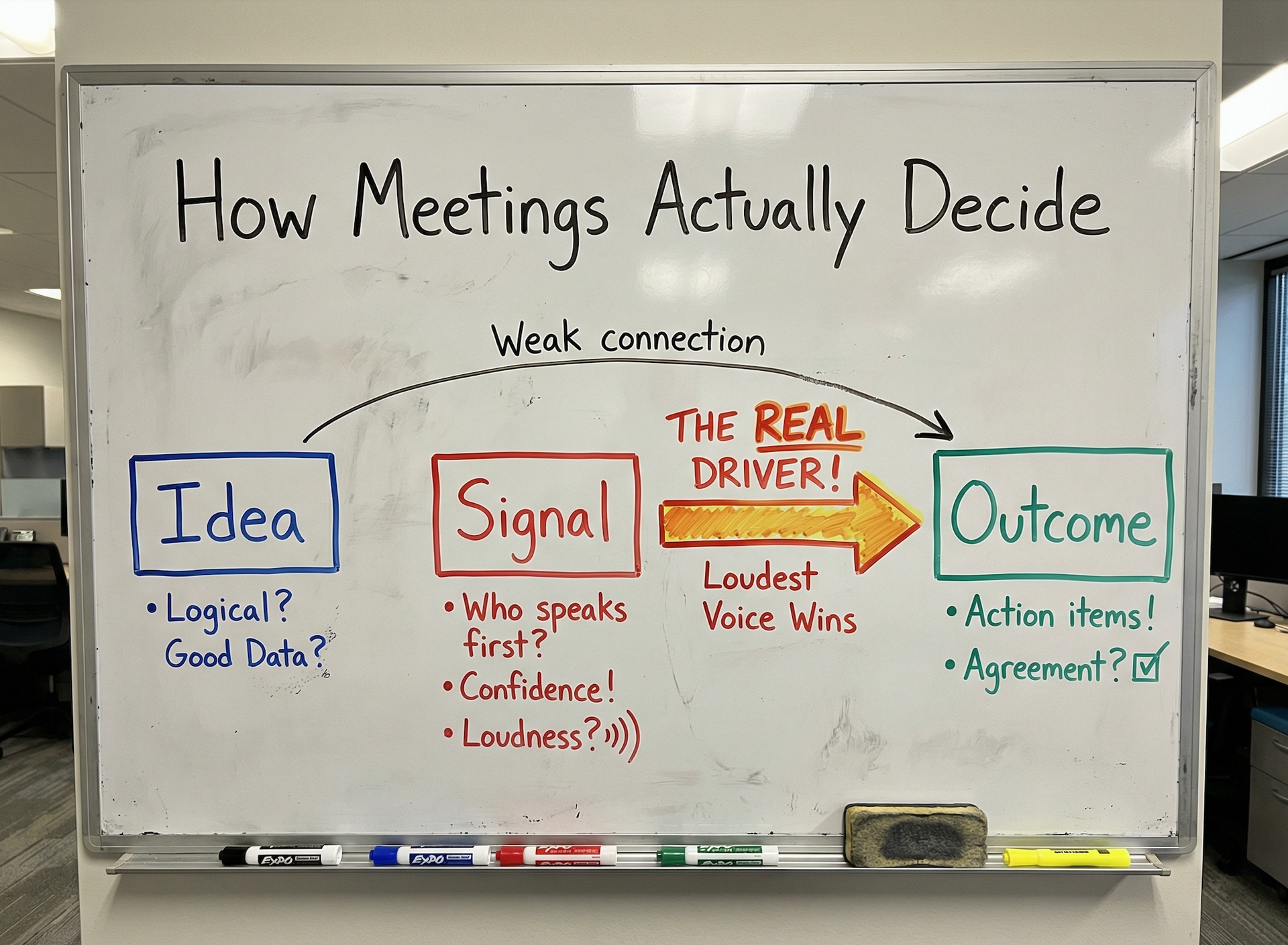
Most meetings do not fail because of bad ideas. They fail because credibility shifts.

The presentation is solid. The logic holds. People nod.

Then alignment slows. Questions increase. Process expands. Decisions drift.


By the time this becomes visible, your influence in the room has already changed.

This gap between what you believed happened and what the room concluded happened is the interpretation gap. It forms quietly and early.

How Credibility Is Judged in Meetings

Meetings are not neutral environments where the best idea automatically wins. They are rapid assessment systems.


When stakes rise, people are not listening for brilliance. They are scanning for stability.


Research in status characteristics theory shows that groups assign competence and influence based on behavioral signals such as decisiveness, predictability, and fluency, often before evaluating expertise.


Before your idea is judged, the room is already asking:

  • Is this leader stable under pressure
  • Will their position hold if challenged
  • Does their communication reduce or redistribute risk

Those judgments come from signals, not intent.


The Four Leadership Communication Signals in Meetings

In every high-stakes meeting, leaders send signals across four tensions. These signals shape credibility and influence.

Authority vs Permission

This signal determines whether the room experiences leadership or hesitation.

Authority is inferred, not announced.


When recommendations are softened or framed as questions, judgment appears provisional. The room compensates with more input, more process, and slower decisions.


Stability vs Volatility

This signal determines trust.

Trust is built through predictability under pressure.


When positions shift mid-sentence or composure drops, oversight increases.

Mistakes are recoverable.


Unpredictability erodes credibility quickly.


Clarity vs Threat

This signal determines whether clarity creates movement or resistance.

Clear direction commits the room. Commitment has consequences.


If clarity arrives faster than the room can absorb impact, debate replaces execution.


Containment vs Trust

This signal explains structural resistance.

When systems perceive risk, they respond with containment.


More stakeholders. More alignment. More governance.

This is not rejection. It is risk management.


The Meeting Signal Audit

There is no score. Notice which statements feel familiar. Discomfort often points to drift.


Authority signals

  • Explaining reasoning before stating the recommendation
  • Framing decisions as questions
  • Being interrupted before finishing

Stability signals

  • Adapting positions while speaking
  • Being asked how you will respond if challenged
  • Feeling pressure to cover every angle

Clarity signals

  • Debate increasing after clarity
  • Decisions slowing
  • More alignment conversations

Containment signals

  • Process increasing after proposals
  • More stakeholders appearing
  • Decisions moving upward instead of outward

How to Restore Credibility in Meetings

Do not change everything. Stabilize one signal first.


When Authority Feels Weak

  • State the recommendation first.
  • Give one reason.
  • Stop talking.
  • Watch for faster decisions.


When Stability Is Questioned

  • Decide in advance what you will not move on.
  • Pause when challenged. Hold the position.
  • Watch for increased delegation.


When Clarity Creates Resistance

  • Separate direction from decision.
  • Name the decision window.
  • Watch process decrease.


When Containment Appears

  • Name the risk yourself.
  • Define guardrails.
  • Invite adoption, not permission.
  • Watch escalation reduce.


One Rule for Leadership Communication

Do not add context to fix a signal problem. Context only works when trust already exists.

Research by Amy Edmondson shows that excessive qualification can unintentionally signal uncertainty.

When trust is unstable, less explanation often creates more authority.

The only reliable indicator is system response:

  • fewer questions
  • faster decisions
  • clearer ownership


Conclusion

Credibility in meetings does not collapse. It shifts.

Quietly. Socially. Across interactions.

Once perception hardens, recovery is expensive.


While it is still forming, small signal changes compound fast.


Lexxy exists to restore visibility into these patterns, helping leaders see how credibility is evolving before outcomes slow and influence erodes.


FAQ

Why do meetings fail even when ideas are strong

Because credibility shifts through communication signals before ideas are evaluated.

Is meeting credibility about personality

No. It is about how signals are interpreted under pressure.

Can one meeting really affect credibility

Yes. Credibility compounds across meetings, but shifts begin immediately.

Is clarity always good in leadership communication

Clarity creates influence when paired with timing and structure.

How does Lexxy help

Lexxy tracks communication patterns over time and surfaces credibility drift before it becomes costly.

Recent Posts

credibility after promotion
By Le Mai Tran February 12, 2026
Executive credibility is not automatic after promotion. Learn the four stages leaders move through to earn trust, authority, and decision weight at senior levels.
How Clarity Creates Influence in Leadership Communication
By Le Mai Tran January 23, 2026
Discover how clarity creates influence in leadership communication, improving trust, decision-making, and team performance.

Why Fixing Your Words Doesn’t Fix Your Communication
By Le Mai Tran January 22, 2026
Learn why fixing your words doesn’t fix your communication and how intent, delivery, and impact shape understanding beyond wording alone.

credibility communication
By Le Mai Tran January 22, 2026
How do you improve credibility through communication? Learn practical strategies to build trust, align intent with impact, and communicate with clarity and consistency.

intent and impact communication
By Le Mai Tran December 31, 2025
Explore the gap between intent and impact communication and how misunderstandings persist even when your message feels clear.
intent vs impact communication
By Le Mai Tran December 18, 2025
Intent vs impact communication explained. Discover the hidden cost of being misunderstood, why it’s hard to spot early, and how misalignment affects trust and relationships.